Gemology · Gemology & Science
How Ethiopian Paraiba Tourmaline Is Identified
Copper-bearing tourmaline cannot be identified by eye. Confirming that a stone is Paraíba-type tourmaline requires a sequence of laboratory tests, each answering a different question. This page explains what each test does and what it cannot tell you.
- By
- Paraiba Ethiopia Editorial Team
- Reviewed by
- Review pending
- Updated
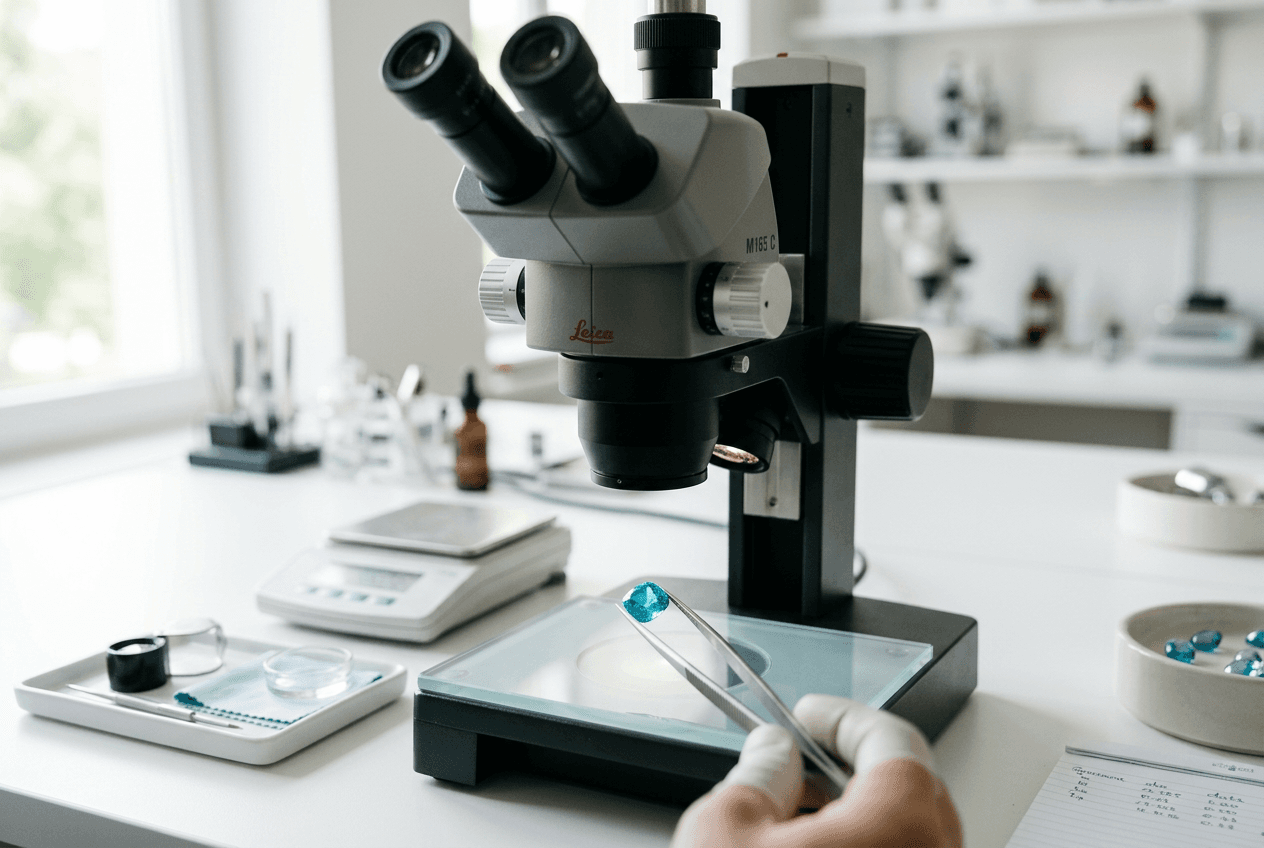
Can you identify Paraíba tourmaline by eye?
No. Colour is suggestive but never conclusive. Iron-coloured tourmaline, apatite, glass and other materials can resemble copper-bearing tourmaline. Identification requires instruments.
The characteristic “neon” glow often attributed to Paraíba tourmaline is a combination of high saturation, good brightness and cutting. It is a useful screening cue but not a test. Experienced dealers routinely send stones to laboratories precisely because visual judgement is unreliable.
What is the laboratory identification sequence?
A typical workflow moves from non-destructive standard tests to advanced spectroscopy and chemistry. Each stage narrows the possibilities until species, chromophore and treatment status are established.
- Step 1
Standard gemology
RI, birefringence, optic character, SG and pleochroism confirm tourmaline-group properties.
- Step 2
Microscopy
Inclusions, growth features and fractures are examined; evidence of filling is noted.
- Step 3
Raman
Confirms the mineral species and can help detect foreign fillers in fissures.
- Step 4
UV-Vis-NIR
Records absorption bands linked to Cu²⁺, Mn³⁺ and Fe²⁺.
- Step 5
Chemistry
EDXRF screens for copper; LA-ICP-MS quantifies trace elements.
- Step 6
Report
Species, variety, treatment comments and any origin opinion are issued.
Which standard gemological tests are used?
Refractive index and birefringence are the first checks. Tourmaline shows a doubly refractive reading with a birefringence typically in the region of 0.018–0.020, together with distinct pleochroism.
| Test | What it shows | Limitation |
|---|---|---|
| Refractometer (RI, birefringence) | Consistent with tourmaline-group minerals | Does not distinguish copper-bearing from ordinary tourmaline |
| Polariscope | Doubly refractive, uniaxial | Same for all tourmaline |
| Dichroscope | Pleochroism — colour changes with viewing direction | Indicative only |
| Specific gravity | Within the tourmaline range | Not diagnostic for copper |
| Magnification | Inclusions, fractures, filler evidence | Inclusions may resemble other sources |
What does microscopy reveal?
Microscopy documents inclusions such as fluid films, growth tubes and partially healed fractures, and it reveals clarity enhancement through flash effects or trapped bubbles in filled fissures.
Copper-bearing tourmaline from several sources is often included. Fluid inclusions, “trichites” and fine growth tubes are common in tourmaline generally. Microscopy is particularly important for detecting oil or resin in surface-reaching fissures, which affects both disclosure and durability.
How does UV-Vis-NIR spectroscopy help?
UV-Vis-NIR spectroscopy measures how much light a stone absorbs at each wavelength. Copper-bearing tourmaline shows broad Cu²⁺-related absorption in the red and near-infrared regions, which helps distinguish it from iron-coloured tourmaline.
UV-Vis-NIR absorption — demonstration template
Demonstration data- ~520 nm Mn³⁺-related region · Literature (general)
- ~700 nm Cu²⁺-related band · Literature (general)
- ~900 nm Cu²⁺-related band · Literature (general)
Absorbing red and near-infrared light while transmitting blue–green light is what produces the characteristic colour. Manganese can contribute an absorption band in the green-yellow region, adding a violet component that is often reduced by heating.
Which chemical tests detect copper?
Energy-dispersive X-ray fluorescence (EDXRF) can detect copper non-destructively and is often used for screening. Laser ablation inductively coupled plasma mass spectrometry (LA-ICP-MS) quantifies copper and trace elements at very low concentrations and underpins origin work.
Chromophore and trace-element panel — template
Template — no values yetPrincipal chromophore discussed for blue to green colour in Paraíba-type tourmaline
Pending · ppmw · LA-ICP-MS / EDXRF
Mn³⁺ can add pink–violet components; Mn²⁺ is largely colourless
Pending · ppmw · LA-ICP-MS / EDXRF
Can shift colour toward darker blue or green and reduce brightness
Pending · ppmw · LA-ICP-MS / EDXRF
Participates in charge-transfer interactions with Fe in some tourmalines
Pending · ppmw · LA-ICP-MS
Trace element sometimes used in origin discrimination
Pending · ppmw · LA-ICP-MS
Trace element sometimes used in origin discrimination
Pending · ppmw · LA-ICP-MS
LA-ICP-MS removes a microscopic amount of material, usually from the girdle, and is considered minimally destructive. Laboratories combine its results with reference databases to compare a stone with known material from different deposits.
Can a laboratory confirm Ethiopian origin?
Sometimes, but not always. Origin opinions rely on reference collections of samples with known provenance. Where reference data for Ethiopian material is limited, a laboratory may decline to state origin.
Frequently asked questions
Is a UV light test enough to identify Paraíba tourmaline?
No. Fluorescence is not diagnostic for copper-bearing tourmaline. Chemical analysis is required.
Is LA-ICP-MS destructive?
It removes a microscopic quantity of material, usually from the girdle, and is generally considered minimally destructive.
Can a gemologist with a refractometer confirm copper?
No. A refractometer can confirm tourmaline but cannot detect copper. That requires EDXRF, LA-ICP-MS or comparable analysis.
References
- GIA reference on copper-bearing (Paraíba-type) tourmaline. Gemological Institute of America (GIA).Citation to be verifiedInsert a specific GIA article or Gems & Gemology paper with authors and year.
- Study of optical absorption spectroscopy of Cu, Mn and Fe in tourmaline. Peer-reviewed mineralogical journal.Citation to be verified
- Study of trace-element approaches to origin determination of Cu-bearing tourmaline. Peer-reviewed analytical or gemological journal.Citation to be verified
- Laboratory guidance on treatment disclosure for tourmaline (heating and clarity enhancement). Recognised gemological laboratory.Citation to be verified
Author
Paraiba Ethiopia Editorial Team
The editorial team researches and writes Paraiba Ethiopia’s educational content on copper-bearing tourmaline, prioritising laboratory nomenclature and published gemological literature over trade claims.
Technical reviewer (assignment pending)
Independent gemological reviewer
Placeholder. A qualified gemologist will be named here once technical review of this page is complete. Until then, treat technical statements as editorially prepared but not yet independently reviewed.
First published 1 October 2026. Read our editorial policy
Continue reading
- SpectroscopyUV-Vis-NIR Spectroscopy of Paraíba TourmalineHow UV-Vis-NIR absorption spectroscopy characterises copper-bearing tourmaline and what Cu²⁺, Mn³⁺ and Fe²⁺ bands indicate.
- ChemistryChemical Composition of Paraíba TourmalineThe chemistry of copper-bearing tourmaline: elbaite structure, chromophores, trace elements and the analytical methods used to measure them.
- MarketCertification of Ethiopian Paraiba TourmalineHow to read a laboratory report for copper-bearing tourmaline: species, variety, chemistry, treatment and origin sections explained.
- GemologyTreatment of Ethiopian Paraiba TourmalineHow copper-bearing tourmaline is treated, what laboratories can detect, and how treatment should be disclosed.
- GemologyGemology of Paraíba TourmalineGemological properties of copper-bearing tourmaline and an overview of the tests used to characterise it.